
Are natural ventilation units big, and hence difficult to install?
Natural ventilation does depend on providing adequate
ventilation area for low-pressure flows driven by buoyancy and wind
forces. The size of apertures required varies from space to space,
and...
Natural ventilation does depend on providing adequate
ventilation area for low-pressure flows driven by buoyancy and wind
forces. The size of apertures required varies from space to space,
and can be relatively large. However, natural ventilation units
compare reasonably in terms of size with mechanical ventilation
equipment such as ceiling-mounted cassette-type air conditioning
units.
We provide an easy to follow installation guide with all our
units, using either standard brackets or unistrut cradles.
More
Are naturally ventilated buildings more expensive to construct?
No. The costs and challenges of ventilation vary from project to
project, but natural ventilation can usually be a cost-effective
option.
No. The costs and challenges of ventilation vary from project to
project, but natural ventilation can usually be a cost-effective
option.
More
Are the units visible within a naturally ventilated buildings?
The e-stack unit itself can be either hidden within a ceiling
void or bulkhead, or visible to the space. If visible to the space,
the units can be painted to any standard RAL colour.
The e-stack unit itself can be either hidden within a ceiling
void or bulkhead, or visible to the space. If visible to the space,
the units can be painted to any standard RAL colour.
More
Can the system be connected to a BMS (Building Management System)?
The system has its own controls hardware and software, which
allows it to operate as a stand-alone system without BMS input.
However, various degrees of interlinking to BMS systems can...
The system has its own controls hardware and software, which
allows it to operate as a stand-alone system without BMS input.
However, various degrees of interlinking to BMS systems can be
realised. Our controllers can include optional MODBUS interface
units to allow communication with other systems. This allows
certain setpoints to be adjusted from the BMS system, as well as
other facilities such as monitoring and logging via the BMS.
More
Can you supply a maintenance service?
We are able to provide a maintenance service. For further
details please contact us on 01223 450060.
We are able to provide a maintenance service. For further
details please contact us on 01223 450060.
More
Do your roof terminals allow water to penetrate through the blades?
No louvre system can ever be guaranteed to be 100%
watertight under all weather conditions, the louvres that we use
are very high performance in terms of rain rejection. The
louvre...
No louvre system can ever be guaranteed to be 100%
watertight under all weather conditions, the louvres that we use
are very high performance in terms of rain rejection. The
louvre blades' weather performance has been tested
in simulated rainfall of 75 litres/hr (equivalent to
around 3 inches rainfall in an hour) at a wind speed of 13m/s
(about 30mph) towards the louvre blades. The amount of
rain which gets through the louvre is measured with no flow through
the louvre, and with various amounts of air inflow through the
louvre blades (measured as design air inlet velocities.) The
E-Stack system operates with air inlet velocities typically under
1m/s when it acts as an air inflow pathway. Water repellent
efficiency is described as a percentage of the incident
rainfall.
Weather performance specifications are as follows for our
louvre systems with insect screen fitted.
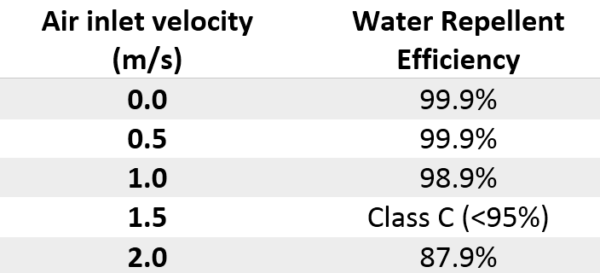
Water Repellent Efficiency (to nearest 0.1%) for
various design air inlet velocities, v using our standard
double-bladed louvre system.
v=0m/s, 99.9%
v=0.5m/s, 99.9%
v=1.0m/s, 98.9%
v=1.5m/s, class C (<95%)
v=2.0m/s, 87.9%
Water Repellent Efficiency (to nearest 0.1%) using
a triple-bladed louvre system.
If a higher level of weather performance is required, a
triple bladed louvre system can be supplied which (to nearest 0.1%)
will provide 100.0% rain rejection for design air inlet velocities
of up to 2.0m/s, under the same test conditions.
More
Does it need seasonal commissioning?
Once the units are installed, we attend site to install and test
software to the system. This automatically adjusts the operation of
the system seasonally and has been developed by drawing on...
Once the units are installed, we attend site to install and test
software to the system. This automatically adjusts the operation of
the system seasonally and has been developed by drawing on our
years of experience in natural ventilation.
However, every building behaves slightly differently, as a
result of differences in construction, layout, location,
orientation and operation. This can necessitate some initial
alteration of setpoints during the first year of operation. We can
provide options for seasonal performance evaluation and adjustment
as required by the customer and/or end user.
More
What wiring do I need?
The system needs a single phase 230V AC mains supply and
requires site wiring to local peripheral devices (sensors, switches
etc.) Typical wiring details can be supplied on request.
The system needs a single phase 230V AC mains supply and
requires site wiring to local peripheral devices (sensors, switches
etc.) Typical wiring details can be supplied on request.
More
Who is best placed to install these systems? How do they know what to do?
Installation is normally carried out by the mechanical and
electrical subcontractor. Breathing Buildings supply an information
pack describing the requirements for installation and provide...
Installation is normally carried out by the mechanical and
electrical subcontractor. Breathing Buildings supply an information
pack describing the requirements for installation and provide CAD
drawings of the equipment.
If required we will be happy to quote for the installation of
our system. This will require appropriate equipment to be provided
on site and can only be completed once all sensors have been wired
into place.
More