
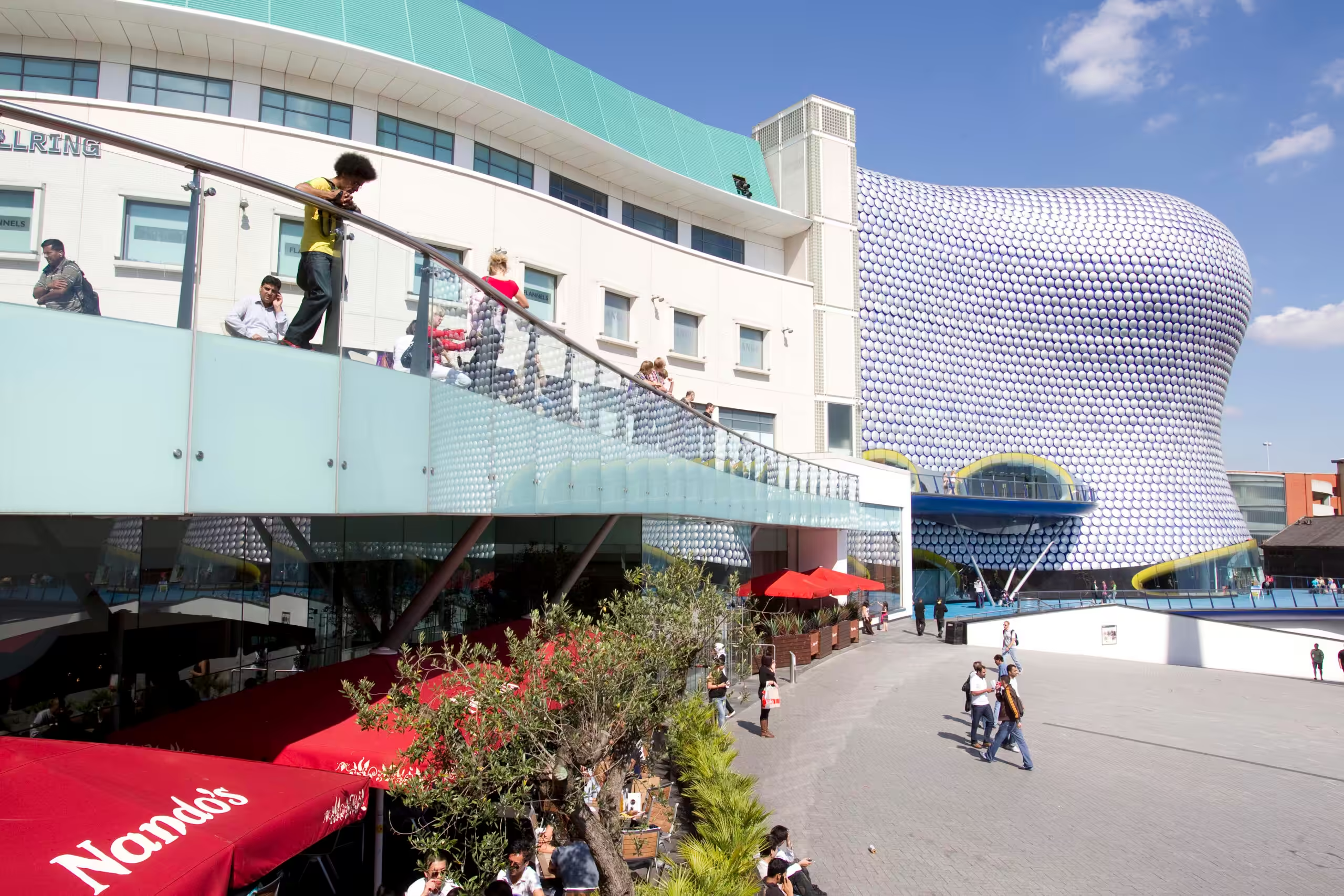
Shopping Mall Case Study

Breathing Buildings are experts in the design of natural and hybrid ventilation. We have worked on hundreds of projects across the UK, are regarded as authorities on the subject, and we would love to help you design the best, lowest-energy ventilation scheme for your building.
Contact us to discuss:
- CF25 Framework Integration
- DfE Technical Manual Compliance
- BB101, Annex 2F & CIBSE TM52 Overheating Analysis
- Low-Energy Hybrid & Natural Ventilation Design
BB101 vs. The DfE Technical Manual: The Operational Shifts
While Building Bulletin 101 (BB101) sets the baseline for school ventilation and indoor air quality, the DfE’s technical manual introduces stricter mechanical, spatial, and structural mandates that supersede legacy standards.
1. Mandatory Crossflow Ventilation
Under the Technical Manual, the DfE explicitly outlines the requirement for crossflow ventilation as the preferred method for teaching spaces.
- The Reason: Crossflow strategies significantly reduce the required size of ventilation openings compared to single-sided ventilation to achieve a given flowrate while making ventilation of deeper plan spaces more achievable. This can help limit the reliance on other mechanically driven ventilation systems, particularly in the more temperate months of the year to maintain thermal comfort.
2. Enhanced Overheating Compliance CriteriaHistorically, BB101 compliance focused primarily on mitigating summer overheating by meeting Criterion 1 of CIBSE TM52 (Hours of Exceedance).
The DfE Technical Manual tightens the net on thermal comfort. When simulating performance against the required 2080 DSY1 (Low Emission 50th Percentile) future climate files, designs must clear a higher bar by now achieving Criterion 1 along with at least one of the two remaining TM52 Adaptive Thermal Comfort overheating criteria.
- Criterion 1 (Hours of Exceedance (He)): The number of hours (He) that ΔT is greater than or equal to one degree (K) during the period *May to September inclusive shall not be more than 40 hours
- Criterion 2 (Daily Weighted Exceedance (We)): To allow for the severity of overheating the weighted exceedance (We) shall be less than or equal to 6 in any one day.
- Criterion 3 (Upper limit temperature (Tupp)): To set an absolute maximum value for the indoor operative temperature the value of ∆T shall not exceed 4 K.
Technical Annex 2F vs. CF25 Framework: Procurement & Performance
When moving from individual technical asset performance (Annex 2F) to the overarching CF25 DfE Framework delivery, the commercial and baseline asset requirements scale up dramatically.
1. Mandatory 5-Year Warranty
The CF25 Framework introduces stringent contractual durability clauses. All primary ventilation, heating, and mechanical assets specified under a CF25 project must be backed by a robust 5-year parts and labour warranty. This shifts the onus onto manufacturers to supply highly durable, low-maintenance hardware—like our field-tested e-stack® and NVHR® lines—reassuring contractors against long-term defects liability.
2. Daily Average CO₂ Cap
While legacy guidance allowed flexibility based on the specific mechanical or natural sub-system chosen, the current alignment under the CF25 Framework demands a stringent average indoor CO₂ level across all core ventilation strategies during occupied hours.
Maintaining this strict average without triggering massive winter heat losses or excessive fan power (SFP) penalties requires smart, dynamic controls. Breathing Buildings' hybrid systems automatically modulate between natural mixing and low-energy mechanical assist to hit these targets flawlessly without blowing out your carbon budget.
